Sign–image distinction
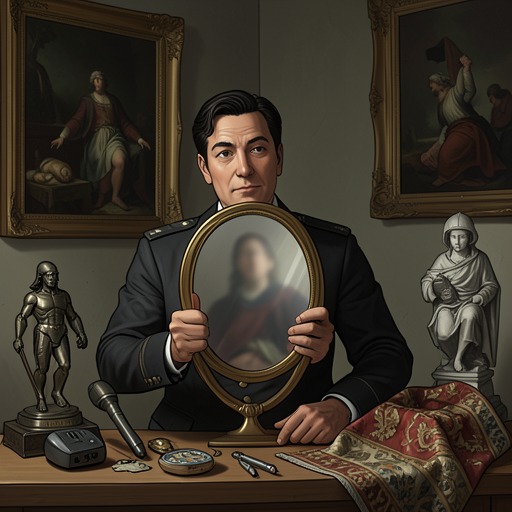
The ImaginaryThe Sign–image distinction concerns two different ways consciousness can reach something that is not physically present. A sign directs attention through a conventional medium toward what it signifies, then leaves that medium behind; an image presents its absent object through a medium that resembles or otherwise makes the object appear. Although both involve a present vehicle and an absent target, their relations to that target, and the acts of consciousness they involve, are fundamentally different. The distinction ultimately extends beyond ordinary pictures and words: it helps explain how a portrait or artwork can present an object as imaginatively present while leaving it unreal.
Shared Structure, Different Relations
A sign and an image initially appear to share a structure. Each involves an intention directed toward an object that is not present, and each uses some present matter through which that object is reached. The black lines on a station placard, for example, are taken up as a sign for the Assistant Manager’s Office. Their physical dimensions, colour, and position cease to matter in themselves; attention passes through them to a place where a claim can be made. The sign does not reproduce the office or bring it before consciousness. It makes the office knowable as the object at which the intention is aimed.
The matter of a physical sign is indifferent to what it signifies. No likeness connects the black marks for office with the complex social and physical reality of an office. Their association arises through convention and is reinforced by habit: without the learned habit that prompts an appropriate attitude when the word is perceived, the marks would not evoke that object. The sign’s usefulness depends on this acquired connection, not on resemblance between its appearance and its referent.
A physical image has a different material relation to its object. In a portrait, the medium is not simply a collection of coloured marks: it presents something like a quasi-person with a quasi-face. Resemblance does not operate as a force that summons a separate mental image. Rather, the portrait can solicit perception of the person as though that person were there. The difference lies in how consciousness takes up the medium: the same present thing can function as a perceived object, a sign, or the basis of an image according to the attitude directed through it.
The Portrait and Its Absent Subject
A brief mistake at a museum in Rouen makes the distinction especially clear. On entering an unfamiliar room, the observer took the people in a large picture for actual men for perhaps a quarter of a second. During that instant the experience was perceptual, not imagistic: the synthesis was mistaken, but it was still a perception. Approaching the painting dispelled the illusion, though the picture’s likeness continued to invite the perceptual response. Only when the observer adopted the attitude that took the picture as a portrait did it function as the medium for an image of its subject.
Once that attitude is adopted, the portrait’s invitation to perceive its subject is incorporated into an imagined synthesis. Details seen in the painting are no longer treated merely as spots of colour; they are assigned to the person. Looking repeatedly at a portrait of Pierre can disclose a wrinkle not previously noticed and add it to the imagined Pierre. The image-directed intention thus returns continually to its medium, and what is noticed there enriches the object that consciousness intends. A sign behaves in the opposite way: it serves as a milestone, awakens its signification, and is then left behind as attention proceeds to the thing.
The portrait of Charles VIII at the Uffizi in Florence displays the more complicated consequences of resemblance. The observer knows that Charles VIII is dead and that the historical person is absent, yet the painted lips and forehead directly produce an affective impression. The lips point toward the long-dead person, while also acting on sensibility as lips visible in the picture. These functions converge: Charles VIII appears present in an image, but is simultaneously posited as not being there. The portrait therefore does not simply signify the king. It makes him appear through a medium that gives him a reduced, incomplete presence, while his imagined identity retains its distance from the painting and its own absolute status.
Intention, Position, and Fulfilment
The central difference is not merely that signs are conventional and images resemble their objects. It also concerns what consciousness does with the object it reaches. Sign-consciousness, considered as such, does not posit the signified object as existent, absent, or nonexistent; it aims at that object without making an affirmation about it. If a person reads the placard, the office becomes the object of the intention, but reading alone does not assert that the office exists. An affirmation can be added, but that produces a further act of judgement rather than changing the sign into an image.
Imaging consciousness, by contrast, has a positional character even when it does not posit its object as existent. In a portrait, the subject may be posited as absent; other images can posit an object as nonexistent. What matters is the character of the intention, not simply whether the object happens to exist. A centaur, for example, can be posited as existent but absent, while people in magazine photographs can be reached through the pictures without their existence being posited. A photograph may also leave an observer so indifferent that no imaging act occurs: its figures are constituted only as people by their resemblance to human beings, floating between perception, sign, and image without settling into any one function.
This difference also explains why a sign can be fulfilled in a way an image cannot. If someone sees Pierre in person after hearing his name, the perception can join with the signification and fulfil it; the sign remains capable of directing consciousness toward an object that is then present. An image, however, is already full in its own distinctive way. If Pierre appears in person, the imaging act disappears rather than being completed by the perception. The image gives Pierre as absent through its medium; it is not an empty pointer waiting for the real person to supply its content.
Schematic Figures and Shifting Attitudes
Schematic drawings show that the distinction depends on a change in the organization of consciousness, not simply on the physical shape of a mark. A few lines can first be taken as unrelated segments organized on a white ground. In a different attitude, the same arrangement becomes a face: one segment is read as a forehead, another as an eyebrow, a descending line as a nose, and a point as an eye. The surrounding paper also changes its role. Space on one side can be taken as the volume of a face, while the other remains an unregarded ground. Eye movements link separated marks, including by enacting an absent line between them, and the body helps animate the figure as a whole.
This image-forming process is distinct from perceptual organization in which a figure imposes movements on the eyes. In the Müller-Lyer illusion, the closed and open angles organize contrary eye movements, and those movements are projected onto the lines as properties: one appears to extend while the other gathers in. The perceived lines acquire directions or vectors, but this remains a perceptual constitution of qualities, not an image as such. In a schematic image, by contrast, knowledge directs exploratory eye movements in order to discover what the lines might yield. Those movements are then projected as hypothetical directions; if a figure crystallizes, the observer sees, for example, a running man while remaining aware that the image has been freely formed. The representative elements are not the lines alone but the movements projected onto them.
Work associated with Wolfgang Köhler, Wertheimer, and Koffka offers a further way to investigate how formal structures persist through changes in position and thereby contribute to perceptual constancy. This helps clarify why perception can include more than what is immediately visible, without requiring images to be inserted into perception. The distinction therefore does not deny that perception is organized or enriched. It separates such organizing structures from the distinct act in which a figure is taken as an image.
Consequences for Art and Aesthetic Experience
The distinction carries into the account of art. The painted Charles VIII is not identical with the real canvas, frame, and layers of paint. Nor can the aesthetic object be given to a realizing consciousness as just another physical feature of that canvas. It appears when consciousness adopts an imaging attitude; the depicted figure is then apprehended as an irreal object. Just as a drawing cannot be seen as five and six cubes at the same time, apprehending Charles VIII as an image belongs to an intentional act that excludes taking the painting simply as a real object.
The painter does not transfer a private mental image into a real canvas and thereby convert the imaginary into reality. The real elements are brushstrokes, texture, and varnish; the aesthetic object is not what ordinary perception finds in those materials. Rather, the artist arranges a material medium through which a spectator can form the image. When the spectator takes up that attitude, the canvas manifests the irreal object without making it real. The work remains a physical thing, visited by an imagined object whenever it is contemplated in this way.
The same account distinguishes sensory pleasure from aesthetic appreciation. A red that pleases the senses in isolation offers a sensory enjoyment, but the red in a painting is apprehended as part of an imagined whole: perhaps the red of a woollen rug beside a table. Its tactile and material qualities, and its relation to the green of a wall covering, belong to the irreal ensemble through which its aesthetic sense emerges. Even abstract or cubist forms need not represent familiar objects to function as an analogical medium. They can manifest new irreal things with density, depth, and relations of perspective. Aesthetic enjoyment is real as an experience, yet it is directed through the physical work toward the irreal object rather than toward the canvas alone.
The distinction also applies to fiction and performance. A novel, poem, or drama makes irreal objects appear through words; an actor uses the body as a medium for an imagined character such as Hamlet. The actor need not believe, in the sense of taking himself to be Hamlet, for his feelings, strength, and gestures to be mobilized in presenting the character. Even real tears can be grasped by actor and audience as Hamlet’s irreal tears. The actor is not simply turning the character into a real person; the performance instead makes the actor’s actions serve the character’s imagined presence. Across portraits, drawings, and the arts, the distinction identifies how a present material medium can make an absent or irreal object available without collapsing image into sign or imagination into reality.